
Part 1: From Open Seas to Open Source - Why Transparency Powers Innovation in Maritime Tokenization
Series - Open Waters: How Open Source Will Power the Future of Maritime

When Satoshi Nakamoto published the Bitcoin whitepaper in 2008, they weren't just creating a new financial system—they were evolving a tradition as old as the internet itself: the open sharing of protocols, the collective improvement of code, and the collaborative development that could take technology further than before.
Sound familiar, sailors?
The Shared Charts of Success
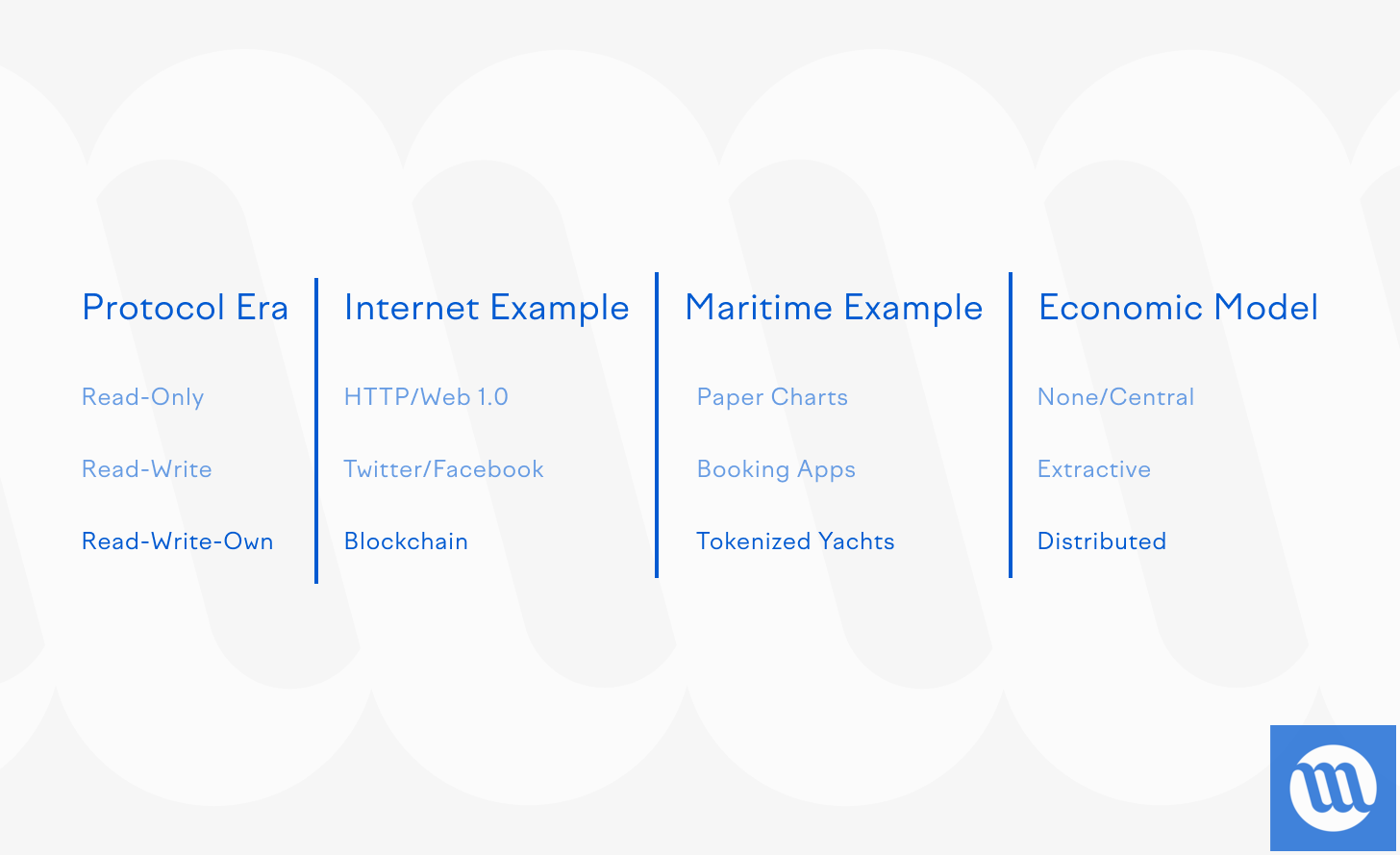
The internet itself was built on open protocols—TCP/IP, HTTP, SMTP—creating a read-only internet where information flowed freely. The social media giants (you know the ones) later enabled a “read-write” era where anyone could publish content. But something critical was missing: a sustainable economic model for these open systems.
As Chris Dixon notes in "Read, Write, Own," protocol networks like email and the web succeeded because they arrived before serious corporate alternatives. But later attempts at open protocols struggled to compete with well-funded corporate networks.
Take RSS for example. Remember that orange icon? RSS was a potential foundation for an open social network, but it couldn't match the features or funding of Twitter and Facebook. And so it faded, outcompeted by platforms that could pay developers to build sleek interfaces and advanced features.
This isn't just philosophical word salad. It's the core problem blockchain solves for the emerging tokenized yacht economy.
When Every Line of Code is Like a Ship's Log
Maritime traditions have always valued transparency. Ship's logs meticulously record every detail of a journey, creating an immutable record that can be referenced in case of dispute or to improve future voyages.
Sound like a blockchain? That's not a coincidence.
The core benefits of open source development mirror the advantages of traditional maritime record-keeping:
Collective Security: Just as harbors become safer when hazards are mapped and shared publicly, open source code becomes more secure when exposed to many eyes
Continuous Improvement: Open protocols evolve faster, just as boat designs improved more rapidly when shipbuilders shared innovations
Trust Through Verification: In both worlds, trust isn't about blind faith—it's about the ability to verify
But traditional open source had a fatal flaw: no built-in economic model. That's precisely what blockchain networks solve through tokenization.
The Protocol Funding Problem, Solved
When a luxury yacht worth millions is tokenized on an open protocol, something revolutionary happens:
The protocol can charge low fees
These fees flow back to the treasury, funding ongoing development
Tokens align incentives between developers, users, and investors
This solves what Dixon calls "the protocol funding problem" – the reason why corporate networks eventually won against earlier open protocols.
In the traditional yacht share model, capital flows to intermediaries and management companies. In tokenized platforms, it flows to the protocol itself and its stakeholders, you and I, creating sustainable yield for participants without the traditional value extraction tax.
As Dixon explains: "Blockchains are the only credible, known architecture for building networks with the societal benefits of protocol networks and the competitive advantages of corporate networks."
The Early Navigators' Advantage
But let's be real—we're still in the early days. We're witnessing the emergence of what Dixon calls the "read-write-own" era of the internet, where users don't just consume and create, but actually own pieces of the platforms they use.
Early internet users navigated an information sea. Early social media users created content waves. But early blockchain adopters actually own portions of the ocean itself.
The same applies to future tokenized yacht platforms. Token holders aren't just customers—they're stakeholders with governance rights and economic upside if the protocol succeeds.
Based sailors who understand the protocol funding problem will be quietly accumulating positions in platforms with the strongest token models
Beyond Technical Transparency
This new model transforms relationships in fundamental ways:
From attract-extract to aligned incentives: Unlike corporate networks that start friendly but eventually extract maximum value (think of Twitter's API restrictions), blockchain networks have fixed rules and aligned incentives
From black box to open systems: The mechanisms controlling booking rights, maintenance funds, and value distribution are transparent and verifiable
From value capture to value sharing: The economic benefits flow to all participants, not just to the platform owners
This creates what Dixon calls "the blockchain network advantage"—an architecture that lets protocols compete with corporations on equal footing while distributing value more fairly.
Where Do We Go From Here?
The tokenized yacht economy is still evolving, but already we're seeing innovations in other industries that would be impossible in closed corporate systems, think:
Community-developed booking optimization algorithms
Transparent maintenance tracking systems
Cross-platform standards for interoperability
Environmental life-cycle analysis
For free members, this is just the surface of what's possible. Our premium members receive detailed analysis of specific tokenomic models powering the most innovative maritime projects, including how they solve the bootstrap problem that plagued earlier protocols. Refer you friends, and get free premium subscription!
The Horizon Beckons
We stand at the beginning of a new era—what Dixon calls "the read-write-own internet"—where open source development finally has a sustainable economic model through tokens.
Just as email and the web transformed society by making information freely accessible, tokenized assets will transform luxury by making ownership accessible, fractional, and liquid.
In the next article in our Open Waters series, we'll examine how non-technical users can evaluate the quality of maritime token projects by examining their open source practices—even without coding knowledge.
This isn't just a new ownership model—it's a complete coordination mechanism upgrade for maritime assets. Probably nothing.
Until then, keep your eyes on the horizon and your keys securely stored.
Ready to navigate the read-write-own era of maritime assets? Join our community of early token explorers in our Telegram group, where we're vibing and discussing how these new incentive mechanisms are creating sustainable open protocols. Come say gm (good morning) and tell us about your maritime interests.